
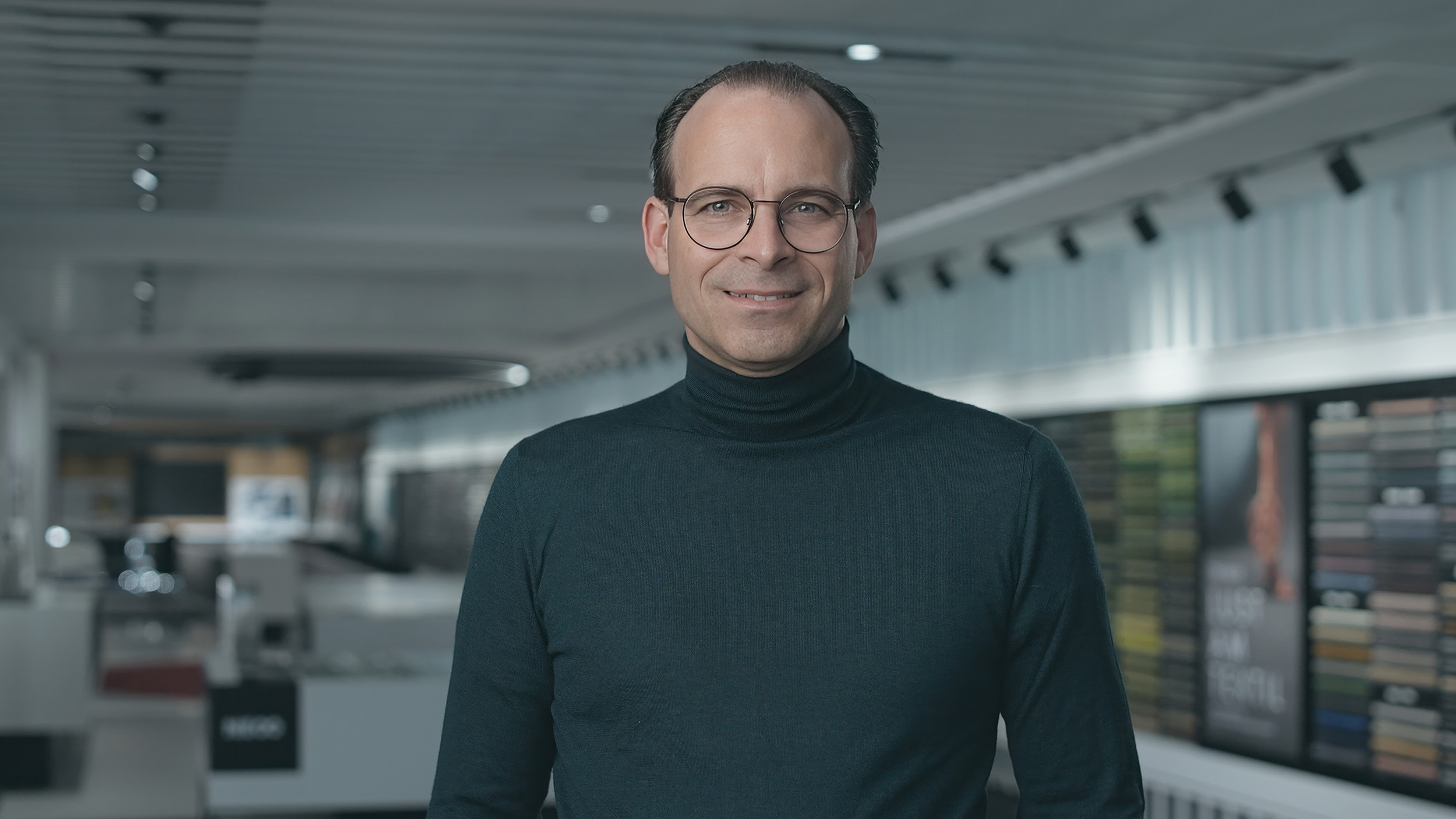
In this interview, Daniel Butz, Managing Director of OBJECT CARPET, explains why materiality is the subconscious language of a space, why analogue does not have to mean nostalgic, and why he sees the future in the circularity of his products.
Mr Butz, to what extent does materiality shape the way we perceive spaces – beyond their purely functional purpose?
Materiality is essentially the subconscious language of a space. It determines how we perceive a room – before we even begin to think about it. The moment we enter, we subconsciously register: What kind of atmosphere is there? Is it cold or noisy? Do I feel comfortable here? These are the first pieces of information we process, even before we form a rational judgement. Through the materials used in its design, a space sends its first message, so to speak. Interestingly, this sensory experience is also what stays with us the longest. Not the floor plan, not the lighting concept, but the feeling a space leaves behind. For us as a carpet manufacturer, this is crucial, because textile flooring is one of the first and most defining elements of a room. Carpets are experienced with the whole body, as they are soft and play with structures and textures.
What is the relationship between the tactile and visual qualities of a space?
We only perceive something as coherent when the visual concept, the materials used, and the quality of their craftsmanship come together as a harmonious whole. Although I personally tend to be more of a visual person, I repeatedly experience how strongly tactile perception either confirms or challenges a visual judgement. What we see, we verify through touch. I was recently invited to a festival at a paper mill. Paper, too, is a material that comes alive through touch. For me, it was impressive to see how much value can be conveyed through haptics alone. Depending on its firmness and texture, an enormous amount of trust can be established simply through touch. Images and words can often be misleading. But when I touch something, I judge within milliseconds how it feels. Material does not lie.
Speaking of quality and trust: What role does traditional craftsmanship play in this context?
To me, craftsmanship is a way of giving products an individual character and conveying a specific attitude. It brings together authenticity and originality. There is one thing that is important to me, however: I do not see skilled craftsmanship and high-tech as opposites. On the contrary, they can work hand in hand. A good example is the DUO technology that we developed together with Niaga. The combination of state-of-the-art manufacturing processes and a finish shaped by traditional craftsmanship creates a product that is responsibly designed and expertly made. The reverse is also true: poor workmanship is always a broken promise of quality.
With regard to authenticity, you recently wrote on LinkedIn: “Analogue is not nostalgic. It’s forward-looking.” How does that fit into an industry in which digitalisation is playing an increasingly important role?
Of course, we live in a world that is becoming increasingly digital and virtual. This inevitably creates a new longing for things that are tangible, perceptible, and real. To me, this is not a trend but rather a correction of the focus that has recently been directed so strongly towards the digital. However, being analogue does not mean longing for the past. Analogue is simply what remains when you switch off the screen. And that is precisely why the future still belongs to the analogue. Because we will never want to live in a completely virtual world. Textile products, in particular, provide a valuable counterbalance. They stand for conscious experience: for retreat, for spaces in which people feel comfortable. That is what I associate with the analogue – not a look back, but a focus on the present and the future.
Would you say that this is also accompanied by a shift in interior design, particularly in the contract sector?
A tremendous amount has changed. The COVID-19 crisis, in particular, was a major accelerator. Today, spaces once again need to provide a reason for people to come – whether it is an office or a hotel. They must be places of interaction, where social life takes place, where exchange happens, and where people come together. This means moving away from a purely square-metre-driven mindset. It is about having less space, but making it better. Health is also playing an increasingly important role – for example, in terms of acoustics and indoor air quality. Today, these factors can be measured quite effectively. The productivity of people in a space with good acoustics is simply higher, which naturally also becomes relevant from a business perspective. In addition, there is the issue of sustainability, which is no longer a nice-to-have but an established standard. The direction is moving away from cheap mass-produced products and towards greater quality awareness, better health, and increased sustainability.
Would you also see a topic like sustainability as a driver of innovation when it comes to design possibilities?Absolutely. Reduction does not mean sacrifice. If I think ecologically from the outset and design a product with the end of its life cycle in mind, the design process gains a different level of coherence and depth. Technical clarity therefore also creates design clarity. With a collection like NEULAND, we at OBJECT CARPET have combined both aspects: a new technology aimed at circularity and a high level of design ambition in terms of tiles, colourways, combination possibilities, and a wide variety of textures and structures.
If you apply the principle of sustainability to the relationship between a company and its customers: To what extent does material also play a role here?
Material remains a promise that can be touched. A customer relationship built on honest products made from high-quality materials lasts longer than any marketing campaign. Let’s take paper as an example once again. An invitation printed on thin, inexpensive cardboard creates a different connection to the sender than one that has been thoughtfully and carefully designed. The same applies to carpet flooring. Material makes a brand tangible and verifiable: I can literally build trust that people can feel. It also communicates a certain mindset and set of values. Through the choice of materials, a company shows what it stands for, and that is essential to any meaningful relationship. After all, whether two parties are a good fit often depends on whether they share similar values.
How important is your status as a family-owned company with a long tradition in this context?
What is special about a family business is that it thinks in generations, not in quarters. That is also a fundamental prerequisite for good craftsmanship. Behind it lies a level of trust that has been built over many years and decades. Our regional roots, our commitment to Made in Germany, and the value creation that takes place here in Krefeld – these are what define OBJECT CARPET and remain unquestionably valuable. As the company’s founder and visionary, my father played a pivotal role in shaping this direction. My ambition is to carry that legacy forward while continuing to build on it and take it a step further.